Monday, September 29, 2008

What I Took from 'Film Criticism in Crisis?'


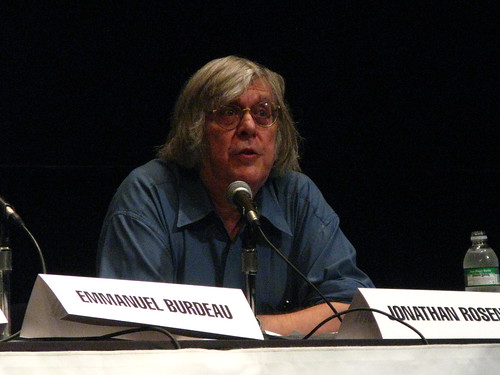
The New York Film Festival hosted a seven critic-panel on Saturday afternoon called “Film Criticism in Crisis?,” moderated by Film Comment’s editor-in-chief, Gavin Smith. The purpose, Smith said, was not to discuss the print vs. Internet debate; “that argument is over and done with.” Instead, the talk was intended to focus on the “larger picture.” Like the fact that David Denby and Richard Brody sat next to each other in the audience?

Film criticism is not in crisis so much as it’s the victim of the many crises going on all around it. Kent Jones, editor-at-large of Film Comment, noted, of course, the economic crisis happening in newspapers and magazines, which has a direct effect on the health of film criticism. But as long as people take criticism seriously, Jones said, the practice itself won’t be in crisis.

But that’s the issue—what role does film criticism play in our culture today? Seung Hoon-Jeong, formerly a writer for the Korean film magazine Cine21, noted that in his native country people look to criticism as a consumer guide, the equivalent of a recommendation from a friend. “They don’t want to suffer from any headache,” he said. Jones noted the same thing happening in this country: “there’s a lot of reviewing,” he said, “not necessarily criticism.”

“Criticism is writing and re-writing,” Jones added. Increasingly, however, editors are encouraging critics to move in the opposite direction.

Film criticism might be in crisis because the national, even international, film culture is in crisis.

Keep reading at The L Magazine's blog.

Thursday, July 24, 2008

Finlandia Through Computer Speakers

THE PHILHARMONIC IN PROSPECT PARK

In my experience, the New York Philharmonic’s incoming musical director, Alan Gilbert, likes to sucker audiences into modernist compositions by sandwiching them into classical programs. But he played the populist at Monday [7.14.08] evening’s populism extravaganza, The Concert in the Park, when uptown elitism is packed into trucks and driven down to Brooklyn for the night. Like Fantasia, the evening began with a piece by popular favorite J.S. Bach.

If you’ve heard one Bach piece, have you heard them all? Maybe not exactly, but his “Concerto for Two Violins in D Major” offered no surprises, though it did provide a relaxing soundtrack, a lovely complement to the encroaching twilight and the orange-streaked sunset sky.

Gilbert compensated for the banal Bach, centerpiecing the evening’s bill with Beethoven’s Fourth. (I’d say it’s one of my favorites, but Beethoven symphonies are like Hitchcock movies: they’re all really good, even the not-so-good ones.) The first movement really danced, as did the fourth, living up to Berlioz’s description of the symphony as “lively, alert and gay.” Last November, I credited conductor Xian Zhang http://www.blogger.com/img/gl.link.gifwith teasing out the terpsichorean rhythms of Beethoven’s Seventh, but now I think it’s simply one of the orchestra’s general talents.

Unfortunately, the guttural throbbings that transition the first movement’s adagio to the allegro vivace were lost as they trickled out of the amplifying sound system. As usual, the park setting juggled its pros and cons—free admission, alcohol and fresh air vs. frat boy chatter, intra-movement applause and thin sound. (Not that, from what I understand, Avery Fisher is an acoustician’s dream.) Though the loose setting made me imagine that this must be what classical music performance attendance is like in China, at least judging from Alex Ross’ recent description.

The intermissionless (don’t they know everyone’s drinking?) evening ended with Sibelius’ “Finlandia,” a piece nightmarish at its start but regal at its conclusion. The Phil played exceptionally, even though it sounded like they were playing through computer speakers.

Like Reel 13’s Saturday night short, the orchestra’s encore was chosen by popular vote; the people chose the “Overture” to Carmen, which Gilbert sped through faster than even the Leonard Bernstein recording. The moment it ended, a fireworks display began, its bangs echoing through Flatbush like gunshots. As gorgeous as it was (better than Macy’s’ two weeks ago), it felt diversionary. A long, steady stream of automobiles, presumably carrying the orchestra, sped away as the people craned their necks towards the lights show. They seemed not to be able to get out of Brooklyn fast enough.

Wednesday, January 16, 2008

Die Walküre at the Met

Date of Performance: January 14, 2008

Seeing as this was my first live Wagner experience, I’m not quite sure where to lay the blame for Die Walküre’s stagnant drama—is it inherent in the opera, and as such the fault of Wagner, who unusually is responsible for both the score and the libretto, or is it the result of Otto Schenk’s production?

The opera boasts a story both complex and absorbing, to the nerd in me at least; based on Norse & Germanic myths, it tells an intricate tale of gods, mortals and the fate of the universe, but despite its epic concerns the opera played out staidly on a dark and drab set (by Gunter Schneider-Siemssen), usually with two characters chatting about what's happened and deciding what to do next while rarely ever offering us a chance to really see anything happen. To me, opera is the king of the arts because of the unique way in which it blends music, drama and spectacle—a way no other art can hope to match—but Die Walküre was too often tame by the standards set by other composers and productions. Not to mention that Wagner's music isn't exactly inviting.

The stiff character of the German tongue doesn't lend itself to lovely sung melodies as does the fluidity of Italian and, to a lesser extent, French, and as such German opera, via Wagner anyway, isn't quite full of the lush arias, duets and ensemble pieces that I’ve come to expect from the opera hall. German opera, and Wagner, are an entirely different breed of music and style.

Though, when he wants to, Wagner proves he’s capable of composing some of the finest music in the repertoire. Wagner is best as a composer of orchestral music—he is an unparalleled overturist—and the reliable, exceptional Lorin Maazel made the score shine from the podium. The quality of the composition or performance (the cast was uniformly superb) wasn't really the problem—what’s most frustrating about Wagner is the tremendous patience he requires. As a friend observed during one of Die Walküre's two well-deserved intermissions, "I'm all for building things slowly, I really am, but that was tough." The first two acts of Die Walküre follow similar structures: long periods of both musical and narrative development that after quite some build-up finally climax in startling moments of great opera. It's a reserved score that, gradually, acquires stirring severity. (Gil Wechsler's gorgeous lighting design followed suit, with acts opening in darkness and slowly coming to startlingly natural-looking light.) There are moments of flowing sweetness, of incomparable sweep, but they are too hard-earned by the audience.

The third act breaks the mold established by the previous acts, though, working almost in reverse as it begins with the explosive and exhilarating bangs of "The Ride of the Valkyries" (amazing!)—the opera's only ensemble piece, with its ten warrior women wailing and scurrying across the stage—and ends with a soft, touching whisper. Well, at least until Wotan (James Morris, an outstanding, dramatic bass) literally sets the stage on fire; Die Walkure, after much build-up, finally has an epic moment that fulfills opera's unique potential for spectacle. Too bad there’s not more of it, especially as, clocking in at just under five hours, Die Walküre can't help but make the audience feel just like its hero Siegmund (looking done up as the Cowardly Lion from up in the Family Circle—costumes by Rolf Langenfass) at the opera's start—collapsed on the floor, begging for water.

Visit the production’s website

Wednesday, November 14, 2007

The Phil Mixes Modernism with Romance

Visit the Official Site

Date of Performance: November 10, 2007

The New York Philharmonic, under the baton of Xian Zhang, began their Saturday evening performance with the New York premiere of two selections from Huang Ruo's Three Pieces for Orchestra, the "Fanfare" and "Announcement". They are both dissonant, percussive and violent pieces of music that the Phil attacked with ferocious gusto; they never sounded anything less than apocalyptic.

Blending Chinese-flavored melodies with a Stravinksy-esque audacity, the dyad ended with a haunting quiet, at least before a gong roll sent the half of the orchestra not wearing ear plugs reaching to cover their ears in advance. When the pieces were done, Huang Ruo came out from the wings to modest and appreciative applause.

With that nod to new music and living composers out of the way, the Philharmonic followed that blazing piece of modernism with two blaringly romantic symphonies, starting with Lalo's Symphonie Espagnole (Op. 21), a madly passionate piece of music met in feeling by the violinist Vadim Repin, who brought a physical intensity to the music as he moved back and forth within his personal square of performance space.

Though called a "symphony", Symphonie Espagnole is, for all intents and purposes, a violin concerto. I admit that, often times, my ears get exhausted during concerti; as I wrote in my last review of the Philharmonic, in reference to Johannes Moser's playing of Tchaikovsky's Variations on a Rococo Theme, "how much consecutive cello can the ordinary ear register?"

I don't know if it was the piece or the performance, but Symphonie Espagnole was captivating; orchestra and soloist were in perfect cooperation, neither outshining the other; they were in perfect balance. The virtuosic solo lines eschewed overreaching into the garish flash that concerti are often characterized by, and served as the wonderful icing on what would have been an otherwise delicious orchestral cake. The audience seemed to agree; Repin got an enthusiastic ovation and several curtain calls.

With a Sevillian strain in the music—Symphonie Espagnole initially premiered right around the time that Bizet's Carmen did—the pre-intermission half of the evening was particularly ethnic.

But that all ended as the evening's performance concluded with a performance of Beethoven's Symphony No. 7 (Op. 92). (You could say the symphony is ethnic in its pulsing rhythms, but it'd be a stretch.) Honestly, is there any greater piece of music? Well, possibly, but it was damned near impossible to try and think of one during the Philharmonic's stellar performance. Zhang really brought out the symphony's terpsichorean qualities, matching them with her gyrating conducting performance that found her moving from one side of her rostrum to the other. (Her enthusiasm was a match for the one I often exhibit in the air-conducting privacy of my bedroom.) As the Phil tore through the piece (taking the time, of course, to ache out the superlative second movement, certainly the most gorgeous piece of music ever penned), I finally understood Daniel J. Levitin's op-ed in the Times a month ago calling for dance floors in the concert halls; from the Fourth Tier boxes, I spied several concertgoers tapping their hands and feet to the beat.

To top it all off, during the third movement I spontaneously smiled, and I can't think of the last time a performance or piece of music made me do that.

Monday, October 15, 2007

Tchaikovsky at the Phil: Swan Lake, Pathetique and more

Visit the official site

date of performance: Oct. 13, 2007

At his best, Tchaikovsky vacillates between two extremes: insistently lachrymose melodies and explosively bombastic orchestrations, both in the most wonderful of ways. His emotions are always exaggerated—he wears them not on his sleeve but all over his body—but never insincere; he's melodramatic only in a strictly positive sense, like Douglas Sirk. (They call him an "arch romantic".) And on Saturday night, when Lorin Maazel led the New York Philharmonic in a series of Tchaikovsky pieces, they had the dynamic interplay between the two down pat.

This was in contrast to the Philharmonic's performance under Bramwell Tovey last November, when they played the Nutcracker Suite with what sounded like a mere lack of interest. (That they were playing against the energetic Jazz at Lincoln Center Orchestra was no help, either.) The night began with excerpts from Swan Lake (Op. 20), and from the opening "Scene: Moderato" from Act II, one of the most hauntingly ethereal pieces in the repertoire, you could tell they were in perfect form. That was followed by the alternating, perfectly-measured blusters and lush sweeps of Act I's "Waltz: Tempo di valse", but the real gem of the night was the performance of "Dances of the Swans: Variation V (Pas d'action)". It begins with a ripping harp solo, which gives way to a heartbreaking violin and harp duet; then, just when you think the heart cannot break any farther, it is entirely shattered by the violin's taking up of the duet with the cello. It is as gorgeous as any duet anywhere, from Romeo and Juliette at the balcony to "Au fond du temple saint" and the Philharmonic played it flawlessly, with the soloists nailing the aching phrasings. The finale, "Hungarian Dance," was highly charged and ended with such explosive force that Mr. Maazel was literally sent into the air.

Next was Variations on a Rococo Theme for Cello and Orchestra (Op. 33). The cellist, Johannes Moser, was fine—his playing was elegant and dramatic—but as with most any piece that calls for extended solo it becomes a tad trying after a movement or two. Despite Mr. Moser's admirable virtuosity, how much consecutive cello can the ordinary ear register?

Closing out of the evening was a performance of the Sixth Symphony, the Pathétique (Op. 74), which I last heard the Philharmonic perform this summer in Prospect Park. But the Pathétique is a work so intense that it is lost in the parks, the notes literally drifting away into space. In the concert hall its brashness and tenderness echoed from wall to wall, leaving me stunned, as though I'd never heard the piece before. The symphony is unique in that it ends on a whimper instead of the customary bang (that is pushed up into the third movement, which generated a mistaken round of applause from the crowd; Maazel waited stiffly for it to end), but it's a fittingly plaintive conclusion as Tchaikovsky died several days after the symphony's original premiere.

At the very end of the performance Maazel left his right hand, and the audience, dangling mournfully for several seconds before marking that the piece had ended. It looked like he quickly wiped a tear from his eye as well, and it was good to know he and I were on the same page.

Tuesday, October 9, 2007

unCommon Cause's "As Far As We Know"

refers to a press conference held on Sept. 25, 2007

Kelly van Zile, producer, director and actress with the unCommon Cause Theatre Collective, is doing everything she can to get the group’s play, As Far As We Know, into a theater near you, short of making it into a musical or offending the real-life family on whom the play is based.

The play had an initial run during the Fringe Festival, a New York City multi-media festival, in August as one of 200 shows.

“I think the play deserves to have a bigger audience,” van Zile said today at a news conference. “I’m willing to hear what the artistic compromises might be and listen to them.”

unCommon Cause has now joined-up with commercial producer Jed Bernstein, former president of the League of Broadway Producers, and have two options for the future: either to try and go the commercial route and get to Broadway, or to try to receive grants from more experimental groups like The Public Theater or the Culture Project and stay downtown.

“We’re just trying to leave all our options open now,” she said.

As Far As We Know deals with the story of Private Keith “Matt” Maupin of Ohio, one of the only unaccounted-for American soldiers in Iraq to date and the subject of a 2004 profile in Time. Maupin was kidnapped by insurgents in 2004, and was subsequently seen on two videotapes aired by Al Jazeera. The second allegedly featured his execution, but because of the video’s grainy quality the army declared it to be inconclusive evidence of his death. Maupin remains officially missing and has even been promoted thrice, in absentia.

The play is a fictionalized account of the toll the ordeal has taken on his family. Maupin’s character has been renamed Jake Larkin, and Maupin’s real-life brother has been transformed into a twin sister, played by van Zile.

Van Zile and the play’s director, Laurie Sales, have met with the family, but the Maupins are not involved in the production.

“We told them we’re doing a play,” van Zile said, “and that’s the last thing we ever said to them.”

To get the show on Broadway, the producer told van Zile that unCommon Cause would need to do one of three things: get a major director, a big star or a well-known writer on board.

“Kelly van Zile’s certainly not going to sell $85 tickets,” she admitted.

Gus van Sant at the New York Film Festival


Gus van Sant was on-hand in New York on Monday (10/8) to discuss his new film, Paranoid Park, which was screening there as part of the New York Film Festival. The following are the minutes of the conversation.

There are some spoilers below, clearly marked, as the conversation took place after the screening of the film, so proceed cautiously.

1. The film is based on a novel by Blake Nelson, who was once something of a "savage poet" of Portland but lately has been writing young adult books. van Sant was originally interested in a book called Rock Star Superstar and after expressing that to Nelson, the author sent van Sant the galleys to his book Paranoid Park and, liking it, he decided to adapt that instead. Also, since it's set in Portland, it gave van Sant "something to do in my hometown."

"He did the work," van Sant said of Blake, referring to the basic plot which the director claimed was lifted pretty directly from the source material.

He also noted that the main character is an amateur skater, and is therefore coming to the skating world that the film (and book, presumably) depicts as an outsider, "sort of like us (the audience)".

2. On the music

They edited the film on a Macintosh laptop, which also had assistant editor Eric Hill's iTunes on there. He's "also a musicologist of sorts," van Sant said, and so a lot of the music was chosen from Hill's collection, just sort of playing around in the editing process, "mixing and matching," as van Sant said. The Nino Rota material was taken from van Sant's own record collection; originally, they tried to make modern re-recordings of Rota's music but it didn't quite work out, so they contacted Rota's estate who allowed them to use the music.

3. On Long Takes (Spoiler!)

van Sant said that his whole career he has filmed "longish scenes", three to five minutes. He films scenes as a whole, not line-by-line, and also claimed "I've always worked with non-professionals (actors)." In his last few films extremely long takes have been written directly into the script; he used Elephant as an example, where he would write, say, "boys play football -- six minutes". Paranoid Park's script was only 56 pages long. (That's much shorter than the average film script! --ed.) He shot two angles for most of the dialogue scenes, one from each side of the conversation. These are edited in the film so that half the scene focuses on one character, and the other half on the other. This method of splitting, he felt, was in line with the film's motif of halfs, best expressed in the image of the man cut in half that cuts the film in half.

4. Chris Doyle

The film's cinematographer was Christopher Doyle, who also appears in a small part as the main character's "Uncle Tommy". He was already on the set and they wanted a face for that character, so they stuck him in there. van Sant saw the character of Uncle Tommy as "the gay uncle who had this beach house."

Doyle is known primarily for the work he's done with Wong Kar-Wai; characterizing the process of working with him, van Sant said it was "a lot of discussion, a lot of analyzing."

The skating sequences were shot by a "skate filmmaker", someone who makes skating videos.

5. Gabe Nevins

Someone asked if Gabe Nevins, the lead actor, ever asked critical questions about how his character behaves, or try to input his own self into the role. van Sant said no.

"Maybe he just understood the screenplay," van Sant said. "He was also very unexperienced."

"Maybe we prepped him as well," he added later.

6. The Security Guard (Spoiler!)

The moderator asked about the startling image of the man cut in half, noting that it was unexpected since van Sant's work doesn't usually feature such images.

van Sant noted it was from the book, but that the book had a different grotesque scene. (i.e. not a man cut in half.) van Sant changed it because it "fits thematically, metaphorically."

7. Hipster Horror

Someone asked if van Sant was trying to make a "Hipster Horror Film"

"Hmmmm," he responded, and after a beat answered, "young adult film, that's what I was trying to make."

8. Parallels to previous films

van Sant said the film was similar to Elephant in that it's set in a high school, but that that film was a "meditation on a horrific event I knew mostly through the news." Paranoid Park is a fictional film, so in that regard it's very different.

9. Fire

Someone asked about the role of fire, specifically campfires, in his oeuvre. van Sant admitted that fire has a "primal sort of meaning to me" as it's "where stories used to be told."

The scene near the end of the film in which Nevins burns the pages of the letter he's been writing was originally set in his living room, but they couldn't stage it to their liking (so that you could see Nevins' face and the fire in the same shot) that way so they moved it outside.

10. Casting

To cast the film, van Sant & Co. had an open casting, putting ads in local Portland media and also on MySpace. "Kids just came in," he said, about 1500 of them. They recorded them and then called people back for actual auditions, that is, to read in front of them.

The detectives were real detectives that they got because someone on the casting crew had connections to the police department.

11. Using Academy Ratio

van Sant's last few films were shot in 1.38:1, or full screen format. "Big square format" as he called it. He said he began doing this with Elephant because it was shot for HBO and 1.38:1 is television format. HBO asked him not to because they wanted to "make it seem more like a movie" by having it letterboxed, but van Sant declined. They made a deal that if they shot in 1.38:1 that HBO could show it letterboxed, that they could "cut off the top and bottom" so van Sant "had to make sure no one gets cut off too much."

He said he'd grown tired of 1.85:1 and "that wide screen." He and his directors of photography feel more like photographers, like Diane Arbus, when they can shoot in a square ratio, and it also brings them back to their 16mm student days.

12. Ending

Someone asked if the ending was supposed to mean "business as usual." van Sant eventually said sure. He also said it was "just a bookend of skateboarding," which is used throughout the film as interludes.

13. Different from previous work

Someone asked if he made a conscious effort to make this film different from his previous work. He said there were differences in the story, source material, and style of storytelling, which was more specifically psychological, more old-fashioned in style.

He said, "sometimes it was like Chris Doyle, Wong Kar-Wai," and said at other times it was a hybrid style, more "austere" like Elephant.

14. Film

The moderator asked him if he'd ever go back to celluloid, and van Sant said all his work is celluloid. He's never used HD. How embarrassing.